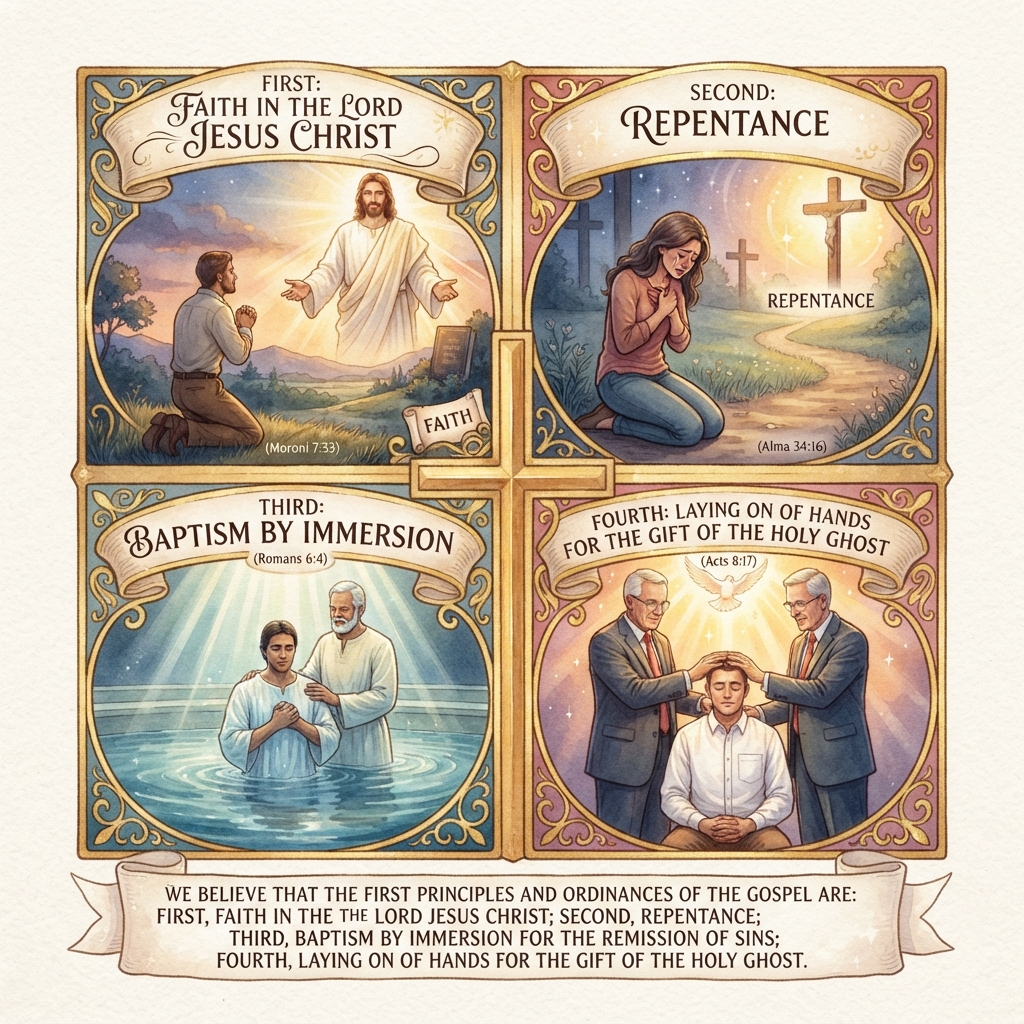
Our spiritual journey begins with faith, repentance, baptism, and the gift of the Holy Ghost.
We believe that the first principles and ordinances of the Gospel are: first, Faith in the Lord Jesus Christ; second, Repentance; third, Baptism by immersion for the remission of sins; fourth, Laying on of hands for the gift of the Holy Ghost. – Articles of Faith 1:4
In the second Article of Faith, we discussed Adam and Eve’s transgression and that we will not be punished for them. We then discussed the Atonement of Jesus Christ all mankind can be saved. How does this work?
In the fourth Article of Faith, we are given the first principles and ordinances of the gospel. These principles and ordinances involve two members of the Godhead, Jesus and the Holy Ghost. Let’s discuss each of the four and see how each one brings us closer to God.
Faith in the Lord Jesus Christ
The first principle is faith in Jesus Christ. What is faith in Jesus Christ?
It means not only believing in Him but placing your trust in Him. Having faith includes hoping for and believing in things that are true, even when you can’t see them or completely understand them. Faith is a principle of action and power that motivates our day-to-day activities. – Topics and Questions: Faith in Jesus Christ
For me, faith in Jesus Christ is believing that the words written about Him are true. That He was born, lived, taught, gave authority to His Apostles, started His church, made Atonement for our sins in the Garden of Gethsemane and on the Cross, was crucified, and was resurrected. It means that when I sincerely repent (discussed below), His Atonement redeems me from sin, and I won’t have to pay the price.
Faith in Jesus Christ also means that He will return one day to finish God’s plan and redeem all who are willing to follow God and keep God’s commandments.
Finally, faith in Jesus Christ means that He has an active role in His church today. He leads the church through His prophet, Dallin H. Oaks.
Without faith in Jesus Christ, the other three principles and ordinances of the gospel are meaningless.
Repentance
What is repentance? “Repentance is God’s gift to us.” God knew that we would not be perfect in mortality. We would make choices that would separate us from Him. Because of the Atonement of Jesus Christ, we have the opportunity to be forgiven of our mistakes. This opportunity is repentance.
Repentance is a process. As I said above, we first have to have faith in Jesus Christ. That is the first step. Next, we must feel sorrow for our sins. We cannot obtain forgiveness if we don’t feel like we made a mistake. Third, we must confess our sins. For most sins, that confession is between the sinner and God. We go to Him in prayer and confess our wrongs. Fourth, we forsake the sin. This means we do all we can to not commit the same mistake again. We don’t have to be perfect in this step. If we falter, we can start over and repent again. The key is to do all we can to not falter. Fifth, we make restitution for the mistakes we have made. Restitution also requires effort. Sometimes it’s not easy. However, when we do all we can to make things right, we are showing sincere repentance. Finally, we try to live righteously. We can do this by living the primary answers. Trying each day to stay as close as we can to the Lord and putting Him first shows we love Him and want to be like Him.
I believe that I have reasons to repent daily. I’m not perfect, and I do things each day that push me away from God. I know that repentance works. Having an addiction and overcoming it allowed me to implement the repentance process and truly feel forgiven. I know that repentance lifts burdens from our shoulders. It frees us from the guilt associated with sin.
Baptism by Immersion
Through revelation, Joseph Smith restored the correct form of baptism. That is, by immersing the person being baptized completely in water. In Doctrine and Covenants 20:73-74, we see that the restored church of Jesus Christ is to perform baptisms by immersion.
The scripture referenced above shows that baptism is to be performed by one who has been given authority. Jesus Christ Himself was baptized by someone who had authority, John the Baptist.
Today, if I were to pull a car over for speeding, would the ticket I write be valid and enforceable? No. Why? I am not an officer of the law who has authority to perform that action. Baptism is the same. A person can’t go out and start baptizing without having received authority from God. In Christ’s time, John the Baptist had that authority. In modern times, John the Baptist gave that authority to Joseph Smith and Oliver Cowdery (see Doctrine and Covenants 13).
The method of baptism is also important. We read in Romans 6:4, “Therefore we are buried with him by baptism into death: that like as Christ was raised up from the dead by the glory of the Father, even so we also should walk in newness of life.”
When Jesus was baptized, we read, “And Jesus, when he was baptized, went up straightway out of the water” (Matthew 3:16). “Up straightway” means that He was immersed by John during the baptism.
Immersion then is the proper way to be baptized. Baptism is to be performed when we are accountable for our actions. Given that repentance is needed for baptism to be effective, one must have the capacity to repent. In the Church of Jesus Christ of Latter-day Saints, revelation has been given that the age where one is accountable is eight (see Doctrine and Covenants 68:27).
Baptism is an important step in our spiritual journey. One, it washes away our sins. Two, it shows our commitment to following Jesus. Three, it is a required covenant between us and God that He has made as part of His plan for our happiness. Fourth, it is the gate through which we become members of Christ’s church.
I was baptized when I was 8 years old. I wasn’t baptized the month of my birthday. My wise mother wanted to be sure I was ready and wanted to be baptized. Three months after my 8th birthday, I entered the waters of baptism.
I don’t remember a lot from that day. However, I do remember that when I was baptized, I kept my eyes open. I remember seeing up through the water. I told this to the person who performed my baptism and he remarked that every part of me was baptized. I felt clean.
The Gift of the Holy Ghost
The last of the four principles and ordinances is the gift of the Holy Ghost. When Jesus was baptized, the Holy Ghost descended in the form of a dove and rested upon Him. The Apostles were given authority to bestow the Holy Ghost upon baptized believers. We read in Acts 8:17, “Then laid they their hands on them, and they received the Holy Ghost.”
Similar to baptism, the gift of the Holy Ghost is given by one who has authority. It is also given by the laying on of hands. This is separate than being influenced by the Holy Ghost. The influence of the Holy Ghost can be felt by anyone, baptized or not. The gift of the Holy Ghost can only be given by someone who has that authority.
The authority for giving the gift of the Holy Ghost was given to Joseph Smith and Oliver Cowdery by Peter, James, and John, Jesus’s apostles. This authority restored the ability to give the gift of the Holy Ghost.
Why is the gift of the Holy Ghost important? In our Sacrament meeting, we partake of bread and water just like Jesus gave to His apostles at the Last Supper. Before partaking, there is a blessing bestowed upon these emblems. In that blessing the phrase, “that they may always have his Spirit to be with them” (Doctrine and Covenants 20:77). The Spirit mentioned is the Holy Ghost. This is a renewal of the covenant made and is God’s promise that the Holy Ghost can be a constant companion to those who keep their covenant.
I received the gift of the Holy Ghost after my baptism. I remember the hands being placed on my head and the words “receive the Holy Ghost” being said. There was a feeling of warmth when those words were said. However, it wasn’t until later in life that I truly learned what a valuable gift I was given. When I was in a spiritual crisis and needed to know, it was the Holy Ghost that confirmed the truth to me. As life has progressed, I have felt that gift as part of my life, guiding me, prompting me, teaching me. He has been a constant companion and has strengthened my faith in God and Jesus Christ.
Conclusion
These then are the first principles and ordinances of the gospel. Faith in Jesus Christ and repentance are repeatable actions we perform every day. Baptism and the gift of the Holy Ghost are one-time ordinances. Together, they mark the beginning of our spiritual journey home to God.
 Whether By Mine Own Voice

Leave a comment