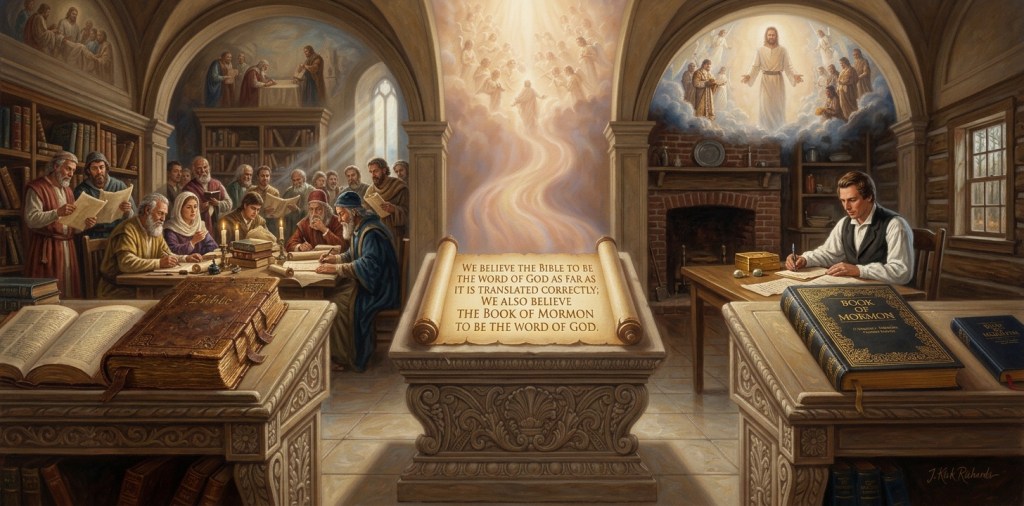
We believe the Bible to be the word of God as far as it is translated correctly; we also believe the Book of Mormon to be the word of God.
In the Church of Jesus Christ of Latter-day Saints, we believe in recorded scriptures throughout Earth’s history. For many in the Christian world, this scriptural record consists of the Old and New Testaments of the bible. We believe God has spoken to all of His children and that the Bible isn’t the only source of His word. We believe the Book of Mormon to be the Word of God. We also believe that there may be other records of God’s word to His children yet to be discovered.
Bible Translation
Doing research, we find that the biblical record was written in many languages. The Old Testament was primarily written in Hebrew. Some parts are written in Biblical Aramaic, and some books in the Catholic and Eastern Orthodox churches are written in Koine Greek.
The New Testament was primarily written in Koine Greek. Some argue that certain texts may have originally been written in Hebrew or Aramaic, but sources have not been found. Scholars have found textual hints suggesting Koine Greek was the written language of the New Testament.
For Joseph Smith, the text would only have been readable in English. That means that both the Old and New Testaments required a translation into English. Gemini compiled the following table using the prompt, “Create a table of the major historical translations of the Bible into English starting with the first recognized translation to the present time.”
| Translation Name | Year Completed | Translator(s) / Committee | Source Text & Key Distinction |
| Wycliffe’s Bible | 1382 (revised 1395) | John Wycliffe, Nicholas of Hereford, John Purvey, and associates | Latin Vulgate. First complete handwritten Bible in Middle English; produced before the printing press. |
| Tyndale Bible (NT & parts of OT) | 1526 (NT); 1530–1535 (OT portions) | William Tyndale | Greek & Hebrew. First English translation directly from original languages and first mass-produced via printing press. |
| Coverdale Bible | 1535 | Myles Coverdale | Tyndale’s work, Latin, & German. First complete printed Bible in English. |
| Matthew Bible | 1537 | John Rogers (under pseudonym Thomas Matthew) | Tyndale & Coverdale. Combined Tyndale’s untranslated OT manuscripts with Coverdale’s work; first legally authorized by King Henry VIII. |
| Great Bible | 1539 | Myles Coverdale (commissioned by Thomas Cromwell) | Matthew Bible & Latin. First official Bible mandated to be placed in every Church of England parish. |
| Geneva Bible | 1560 | William Whittingham, Anthony Gilby, Thomas Sampson, and Marian exiles | Hebrew & Greek. First English Bible with numbered verses, study notes, and Roman type; carried by the Pilgrims to America. |
| Bishops’ Bible | 1568 | Matthew Parker (Archbishop of Canterbury) and Church of England bishops | Great Bible, Hebrew, & Greek. Created to counter the Calvinist study notes of the popular Geneva Bible. |
| Douay-Rheims Bible | 1582 (NT); 1609–1610 (OT) | Gregory Martin, William Allen, Richard Bristow | Latin Vulgate. First official Roman Catholic English translation; heavily revised by Richard Challoner in 1749–1752. |
| King James Version (KJV) | 1611 | 47 scholars across six committees in Oxford, Cambridge, and Westminster | Textus Receptus (Greek) & Masoretic Text (Hebrew). Commissioned by King James I; became the dominant English Bible for over three centuries. |
| English Revised Version (ERV) | 1881 (NT); 1885 (Complete) | British scholarly committee (with American consultation) | Critical Greek texts (Westcott-Hort) & Masoretic Text. First major official revision of the KJV using older, newly discovered Greek manuscripts. |
| American Standard Version (ASV) | 1901 | American Revision Committee | Critical Greek & Hebrew texts. The American counterpart to the ERV, adapting language and readings for U.S. readers. |
| Revised Standard Version (RSV) | 1946 (NT); 1952 (Complete) | Standard Bible Committee (led by Luther Weigle) | Critical Greek & Hebrew texts. Major mid-20th-century ecumenical update of the ASV that dropped archaic pronouns (“thee/thou”) for people. |
| The Amplified Bible (AMP) | 1958 (NT); 1965 (Complete) | Frances E. Siewert and the Lockman Foundation | Critical Greek & Hebrew texts. Uses bracketed synonyms and explanations to unpack nuanced meanings in the original languages. |
| New American Bible (NAB) | 1970 (revised as NABRE in 2011) | Catholic Biblical Association of America | Hebrew, Aramaic, & Greek. First American Catholic translation made directly from the original biblical languages rather than the Latin Vulgate. |
| New American Standard Bible (NASB) | 1963 (NT); 1971 (Complete) | The Lockman Foundation Translation Committee | Critical Greek & Hebrew texts. A strict formal-equivalence (“word-for-word”) update to the 1901 ASV. |
| The Living Bible (TLB) | 1971 | Kenneth N. Taylor | American Standard Version (ASV). A single-author thought-for-thought paraphrase designed for accessible everyday reading. |
| Good News Translation (GNT / TEV) | 1966 (NT); 1976 (Complete) | Robert G. Bratcher and the American Bible Society | Critical Greek & Hebrew texts. Pioneered “dynamic equivalence” (thought-for-thought) translation for clear, natural English. |
| New International Version (NIV) | 1973 (NT); 1978 (Complete) | Committee on Bible Translation (100+ international scholars) | Critical Greek & Hebrew texts. Balances word-for-word accuracy with thought-for-thought readability; became the best-selling modern English translation. |
| New King James Version (NKJV) | 1979 (NT); 1982 (Complete) | 130 scholars, church leaders, and editors (Thomas Nelson) | Textus Receptus & Masoretic Text. Updates the vocabulary and grammar of the 1611 KJV while preserving its traditional manuscript base. |
| New Revised Standard Version (NRSV) | 1989 (Updated as NRSVue in 2021) | National Council of Churches Committee (led by Bruce M. Metzger) | Critical Greek & Hebrew texts (including Dead Sea Scrolls). Standard academic and mainline Protestant translation; introduced gender-accurate language for human references. |
| New Living Translation (NLT) | 1996 | 90 evangelical biblical scholars (Tyndale House) | Critical Greek & Hebrew texts. Replaced The Living Bible by translating directly from original texts rather than paraphrasing English. |
| English Standard Version (ESV) | 2001 | ESV Translation Oversight Committee (led by J. I. Packer) | Critical Greek & Hebrew texts. Adapted from the 1971 RSV text to restore more traditional, formal-equivalence (“essentially literal”) phrasing. |
| The Message (MSG) | 1993 (NT); 2002 (Complete) | Eugene H. Peterson | Critical Greek & Hebrew texts. An idiomatic contemporary paraphrase rendered directly from the original languages. |
| Christian Standard Bible (CSB) | 2017 (revised from 2004 HCSB) | 100 scholars from 17 denominations (Holman / Lifeway) | Critical Greek & Hebrew texts. Uses an “optimal equivalence” approach blending literal precision with natural modern English. |
Which translation is the correct one? I don’t believe anyone can answer that question. This is why the eighth Article of Faith has the phrase, “as far as it is translated correctly.” We believe that men have done their best to translate the words. However, the translators are not prophets of God who can be guided by revelation to know the exact translation of the records.
Given that, we still affirm that the Bible is the word of God. It contains a record of God’s people in the Old Testament. It contains the life and ministry of our Savior Jesus Christ in the New Testament. The New Testament also contains the words of Christ’s chosen Apostles during their lives.
Book of Mormon Translation
In contrast to the many translations of the Bible, the Book of Mormon was translated by one person. Joseph Smith was entrusted with the Gold Plates on September 22, 1827. He was not a scholar. He had a third-grade education. He did not know a language other than English.
He had one thing the Bible translators didn’t/don’t. He was called to be a prophet of God. He was told that he could translate the record and publish it to the world as “Another Testament of Jesus Christ.”
I won’t relate the history of this effort. You can find that in Joseph Smith History. With the help of scribes, Joseph dictated the writings from the plates. He compiled them, secured a copyright, a publisher, and brought the work to the world.
One translator: a prophet of God through whom God ensured that the translation would be correct.
Why Do I Believe?
Why do I believe the Bible to be the Word of God? As in all things spiritual, I have sought the truth by asking God. Through the Holy Ghost, He has revealed to me that the Bible has His word. It’s not a perfect account, but it’s not completely wrong.
Why do I believe the Book of Mormon to be the Word of God? By the same process. A revelation from the Holy Ghost that it is God’s word and scripture.
Reading both books brings me closer to God and Christ. The truths of God’s plan for us are contained therein. The passages teach me and help me to be my best as a son of God.


Leave a Reply